Two projects went live recently, and together they show how different the right answer can be. One client needed a page that loads in a second and answers the question "how much does it cost". The other needed a catalogue of several thousand products with filters, a cart and checkout. Here is how both went.
YO AUTO — a landing page for a paint and body shop
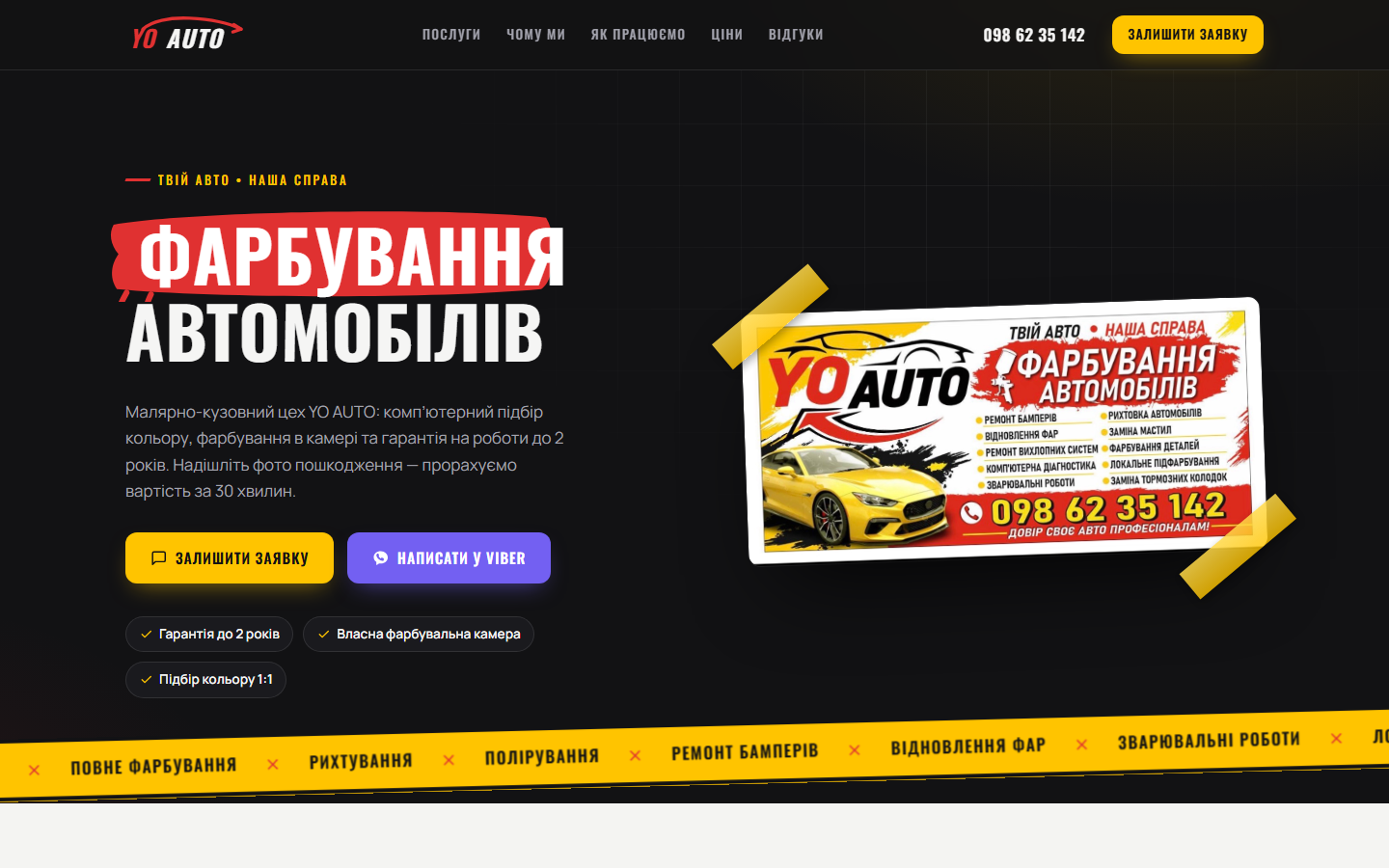
YO AUTO is a paint and body shop with its own spray booth: 12+ years in the trade and more than 2,500 cars painted. There was no website at all — everything ran through phone calls and Viber. Every call started with the same questions: how much to respray a fender, will the colour match, how long will the car sit in the shop.
What we built
A single-page landing built around one path: see the price → send a photo → get a quote.
- 11 services with a short description of the technique and a "from" price — from a local chip touch-up to a full respray and turnkey post-accident repair
- A separate price list of 11 positions, so nobody has to call just for a ballpark figure
- An "Exact price in 30 minutes" flow — three steps with damage photos over Viber instead of a shop visit
- Technical arguments instead of slogans: spectrophotometer colour matching, 60 °C booth curing, Sikkens, Standox and 3M materials, a written warranty of up to 2 years
- A 5-step process explainer, a shop gallery, testimonials naming the car and the work, and a 6-question FAQ
- A lead form with service selection and a duplicate Viber button in every section — on mobile, the messenger converts better than a form
Why a static site
We deliberately skipped the CMS here. The shop's content changes rarely — the price list maybe twice a year — and speed and reliability matter more than editing text from a browser. So the site is plain HTML with hand-written CSS and vanilla JS, no Bootstrap, no Tailwind, no frameworks:
- about 21 KB of styles and 1.3 KB of scripts for the entire page
- Oswald and Manrope self-hosted as woff2 with a Cyrillic subset — zero external requests to Google Fonts
- nginx serves the finished HTML directly, with no PHP and no database
Under 60 KB of code in total. For a body shop that is the whole point: most enquiries come from mobile, often on a weak signal, and a page that thinks for three seconds never survives long enough to show its prices.
Service F1 — an online store with 6,000+ items
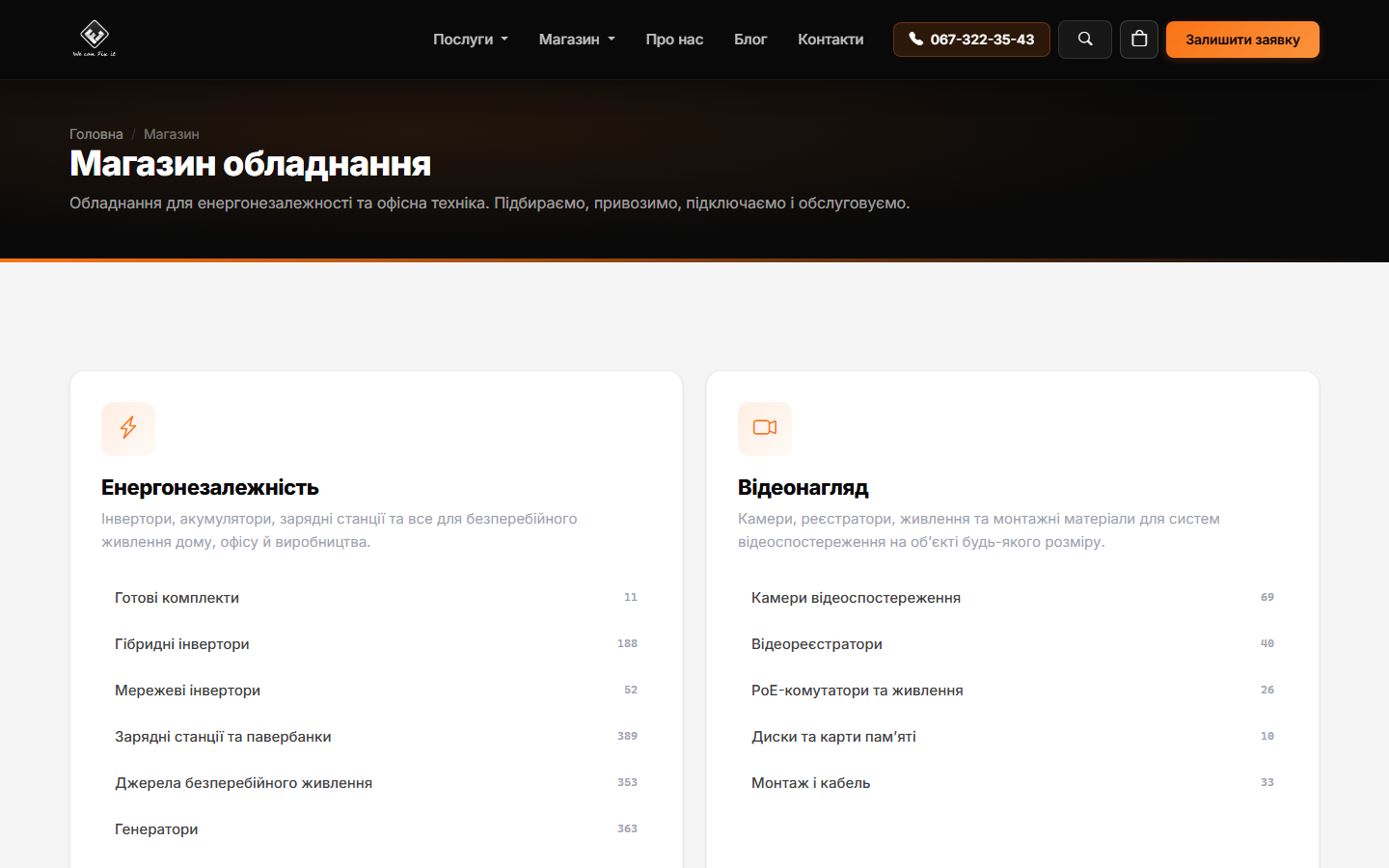
We originally built the Service Center F1 website on our own StartOnline CMS as a services site: laptop, computer and printer repair, cartridge refills, video surveillance. The next step was selling equipment, so we added a full online store to the existing site.
What is inside
The catalogue is split into four directions:
- Power independence — hybrid and grid inverters, power stations, UPS units, generators, stabilizers, lithium and AGM/GEL batteries, solar panels, charge controllers, mounting hardware
- Video surveillance — cameras, recorders, PoE switches, drives and memory cards, cable
- Network and office — routers and access points, switches, server cabinets, patch panels, structured cabling
- Office and computer equipment — printers and MFPs, copiers, cartridges, laptops, monitors
Together that is over 6,000 product listings across nearly thirty subcategories.
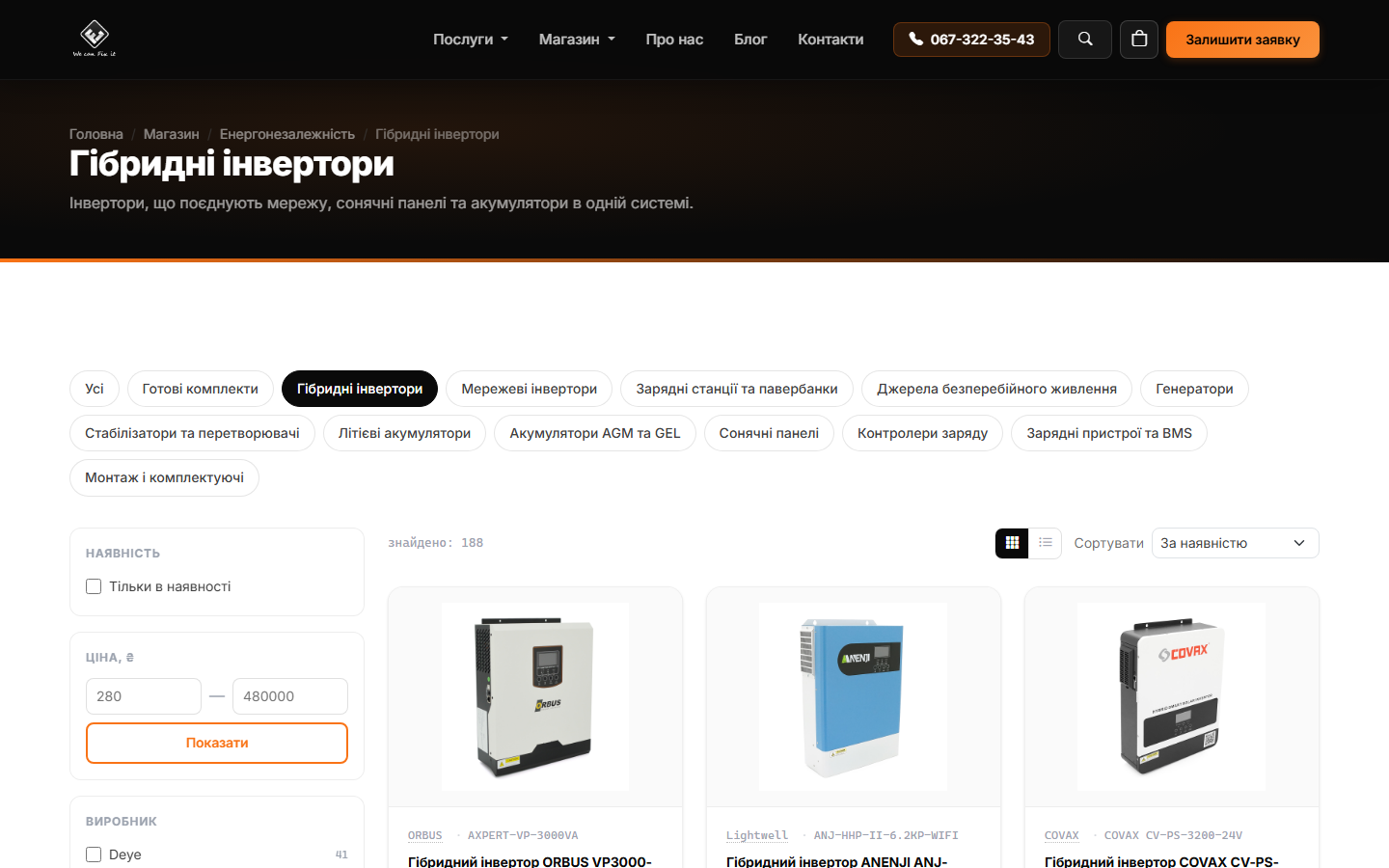
To make that volume navigable, we added:
- Filters by availability, price range and manufacturer — with a product count next to every brand
- Sorting and two view modes: a photo grid and a compact table for comparing specifications
- Manufacturer pages — pick a brand and see all of its equipment across the whole catalogue at once
- Live search in the header with suggestions as you type
- Cart and checkout with payment methods and a public offer
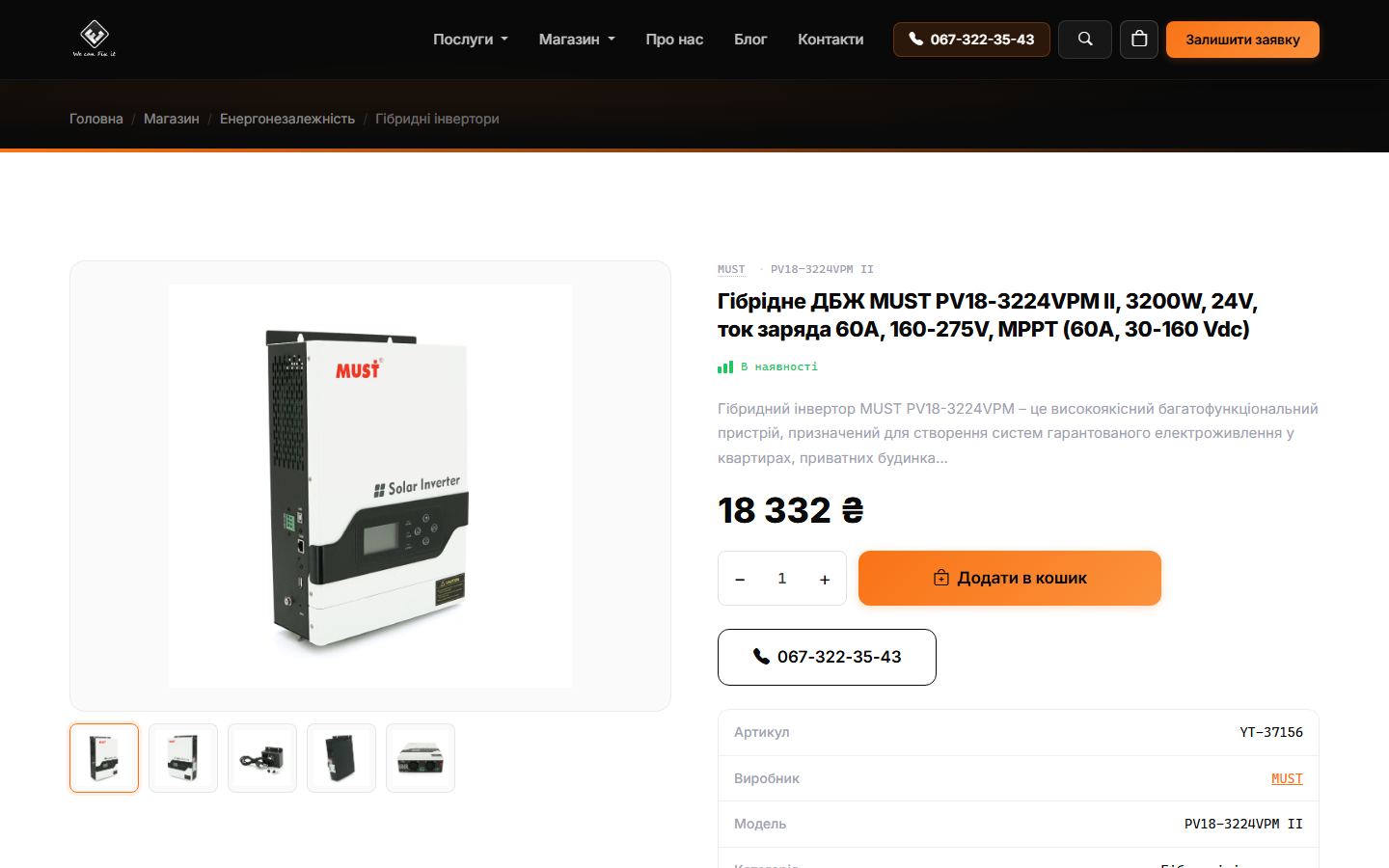
One technical note worth making: the store grew inside the same CMS that runs the services site. It is implemented as a theme, with no changes to the core — so CMS updates break neither the store nor the service pages, and new platform features reach the client's site along with the update.
The takeaway
Two projects in the same period, two opposite decisions. A 60 KB landing where speed and a single clear action are what matter. A catalogue with filters, a cart and thousands of SKUs where the site has to work as a real sales channel.
The mistake goes both ways: a heavy CMS with an admin panel for a page edited once a year, or the reverse — trying to sell six thousand products through a static PDF price list. That is why we start not with the platform, but with the question of what exactly should happen after someone opens the site.
Both projects are in our portfolio. If you have a similar task, get in touch — we will tell you which option actually makes sense in your case.